
Akureyri sees itself as the second city of Iceland, anchoring the north with galleries and shops and a quirky outlook facing the Arctic circle, which is a short ferry ride away.
Okay, I consider myself a bit of a foodie. But I’ve had fish and chips in Iceland more than I’ve had fish and chips combined in the last 15 years. Partially because restaurants are so expensive…but also because they have really good fish and chips. It seems to be the national dish. That morning, the AK Fish Company in Akureyri became my second favorite version, but the best was still the one served out of a food truck near the trailheads at Skaftafell.
The skies were gray and cloudy, the rain light but consistent, blown into an inconsistent diagonal by the gusty wind. We suited up in heavy coveralls, rubber rainboots and goggles. We looked like we were going on a moonwalk instead of a whale watching cruise.
As we got out of the harbor, the seas got rougher. The RIB (rigid inflatable boat) crested over each huge wave and slammed like a rock into the wall of the next wave, or into the deep trough, nosediving for a brief wet moment as the Arctic sprayed over the first 4 seats before we rose up again. The only way to avoid back injury was to take most of your weight on bent legs, absorbing each shock as if you were riding a horse. A very large, angry, wet horse.
The first hour and a half, we followed two humpbacks as their backs gently rose above the water for 3 to 6 breaths, spouting into the air, with the final breath punctuated by a higher tail flip as they angled into a longer deep dive. It was amazing to be within 30 feet of these giants. And that would have been enough.
But once in a while you get really, really lucky. Once in a lifetime lucky. We sped towards a small outcrop nicknamed Puffin Island to see a puffin sanctuary before heading back to the harbor. Angel and I sat in the second row of two seats.
To the front of the boat, in the distance, a giant white splash. My heart leaped. Maybe we would get to see one of the other 12 species of whales around Husavik, much less likely than humpbacks. Our Spanish marine biologist Nacho shouted “Whale breaching at 11 o’clock!” A few more seconds, and a giant (do I even need to use that descriptor?) humpback whale launched her body out of the water, twisted and fell back into the ocean, the white churn exploding into the sky.
The boat slowed and we got close to the dissipating white foam left by her last breach. Suddenly, to our left, she launched again, every enormous foot of her entire body leaving the rough ocean, and slapping down with a roar of displaced water, her fluke sideways and fully visible. Everyone on the boat gasped, even the marine biologist. “Oh my god,” shouted Nacho in a Spanish accent, “Beautiful!”


She wasn’t done. For more than an hour, she repeatedly powered herself out of the water in full body breaches, as well as chin lunges, going vertical with her head and then slamming down to the side. She also did three passes of pec slaps with her giant fin. In all, she breached the water 94 times before we had to head into shore. It was the craziest display of acrobatics and spent energy. The amount of energy it takes to breach a body that size is incredible. Though a single breach doesn’t expend much energy, a series of breaches is significant.
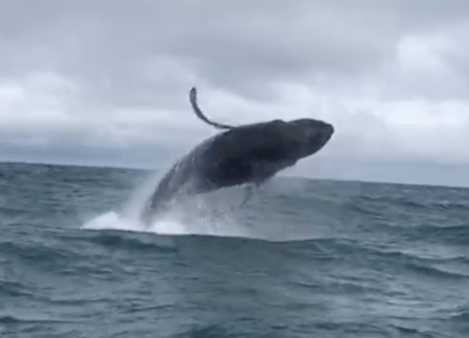
These are sad screenshots of moments that literally stole my breath.
No one is sure exactly why a whale breaches at any particular time. One of the theories is that the loud crashing against the water is a way of communication when the seas are rough and the waves mask the acoustic signals of whale singing. Other reasons, especially for an extended series since a breach is a sign that the whale is physically fit enough to expend this energy, could be to show dominance, to court another whale or warn of danger.
No one is sure exactly why a whale breaches at any particular time. One of the theories is that the loud crashing against the water is a way of communication when the seas are rough and the waves mask the acoustic signals of whale singing. Other reasons, especially for an extended series since a breach is a sign that the whale is physically fit enough to expend this energy, could be to show dominance, to court another whale or warn of danger.
The longest recorded series of breaches was by a humpback in the West Indies totaling 130 leaps in less than 90 minutes. We left at 94, and she was still breaching. It was breathtaking, literally.
 Tom Is Tripping