December 28, 2016
Sapa was a hill station, founded by the French in the early 1900s. It is perched on a mountainside, overlooking terraced rice paddies that climb from the river towards mountain tops almost constantly wreathed in clouds and fog.
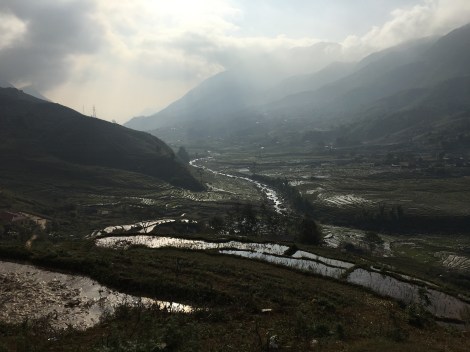
Today, the fog burned off late morning, and it was like a summer day. The first part of the hike was down a paved (I’m using the term loosely) road. I thought, “Oh, we’re going for a walk. How cute that this was labeled a hiking excursion.” Then, my guide, a wide-smiled, tiny and adorable Black H’mong girl named Mai showed me what was up. Suddenly we were off-trail, balancing along the edge of terraced rice fields, which doesn’t sound that bad, except on one edge is a four foot plunge into mud and standing water, and on the other edge is…mud and standing water. The walkway is 9 inches wide, and Mai is walking along it like it was a sidewalk, while I try, unsuccessfully, to not plunge my foot into the quagmire.

This walkway was like a highway compared to some of the trails Mai walked me along.
Of course, Mai giggles “Oops!” sweetly (…I’m pretty sure it was sweetly) the first time I mis-step into the mud. I wore my Palladium boots because they looked cute, but they ended up being far more utilitarian than I intended. We scrambled up and down dirt scrabble paths, across muddy mini-streams, up and down the valley. She stated the obvious about 10 minutes after my first mud encounter, “Easy for me, not so easy for you.” Insert giggle here. No, Mai, I don’t spend a lot of time in LA walking a slippery muddy tightrope through terraced rice fields.
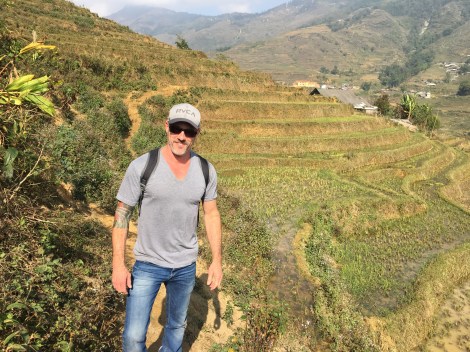
If you could only see my boots, you would know.
The first village was a Black H’mong village, similar to the one Mai lived in. The second village was a Zay village, which looked the same, except for the garb of the women in the Village. The Black H’mong wear almost all black, with brightly colored embroidery as accents.

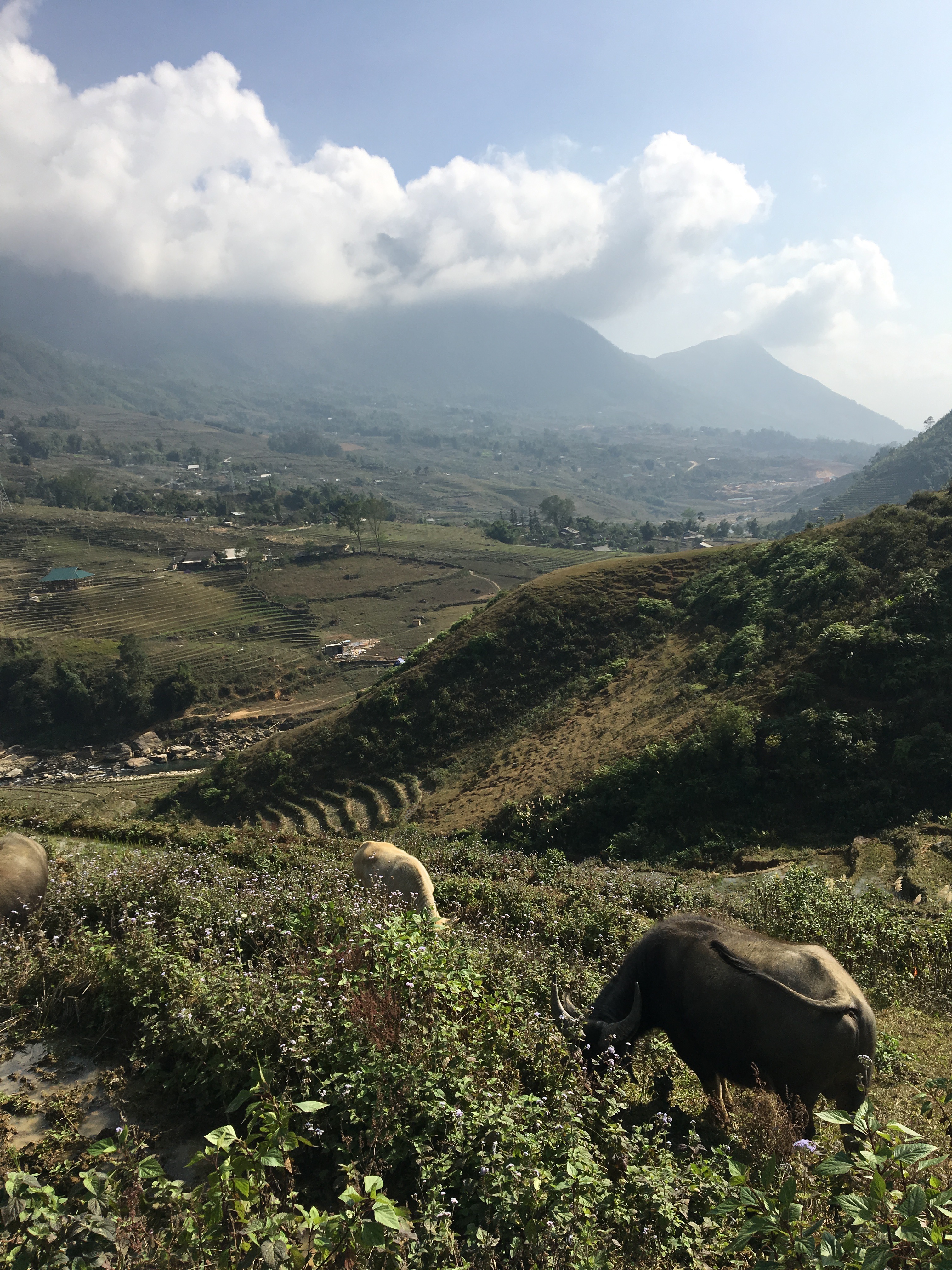
 Water buffalo graze on the steps of the hill, with the random pig or two. The only fences surround small crop gardens, to keep the water buffalo from eating the garden, but I can’t figure out how you lay claim to your pigs or your water buffalo. There are no other fences to keep them in. Do you just know what your particular water buffalo looks like, and when it is time to plough, you go and found him? And what about the pigs? Mai said that most families were very poor and could only afford meat a couple of times a week, so a pig is pretty damn valuable. Do you just trust your neighbors not to steal your pig one day and roast him into unrecognizability?

I wouldn’t have compared my hiking shape to Angel, who hikes like he is in a competition. But 15 kilometers isn’t that long of a hike…unless you are balancing over vats of mud and climbing steep verticals up and down and up again. By the time we got to the 3rd village, I would have raised the white flag, if there were any way to end the hike there. But that’s the thing with hikes in the countryside – you have to hike out to where your car is waiting for you. So, I powered on…which of course was upwards…from that third village up away from the river up the hillside.


—
What is it about travel that draws me (or anyone else) to it? One obvious reason is beauty. There are the sights that you travel for – the temples of Angkor Wat, or the ruins of Macchu Pichu – the marquee guidebook places that awaken a normally dormant sense of wonder. It’s hard to generate a sense of wonder in your day to day world. Maybe that’s part of the definition of wonder for those of us who don’t live in a constant state of Boddhisatva – it comes from the unusual. And often, those marquee places live up to their bucket-list status. I will never forget the ancient stillness of a lesser Angkor temple at sunset, or the view from Huayna Picchu.
But those moments are only half of why I love travel. It’s also in the other ways that travel draws you out of your day to day. I could make the argument that it’s hard to maintain a sense of wonder in my day to day because I’m not surrounded by the overgrown beauty of the Ta Prohm temple, but give me a break. I play volleyball on most Sundays below the cliffs in Santa Monica, with glorious Malibu beaches spread out before me. But no matter how I live in the moment, I’m not that zen yet. I don’t always recognize the beauty in my own day to day.
So, I need travel to draw me out of the day to day. And even when the experience has nothing to do with stunning vistas or ancient architecture, travel does that. I love the realization that I’m doing something as far out of my normal life as possible. I’m bicycling through the noisy chaos of Hanoi, sailing sluggishly down the Nile river, floating with an eerie bouyancy on the top of the Dead Sea, paragliding from an Alpine Meadow in Switzerland, running with the bulls in Pamplona, getting lost in a souk in Fes. How lucky am I to be able to do these things? How lucky I was that my parents built a life that introduced me to travel when I was a child? It’s not hard for me to be grateful about much of my life, but it seems a different type of gratitude when thinking about those experiences, instead of being grateful for my job, or that I can afford a house in a good neighborhood and drive a BMW, and all of those other things that you can check off on a “I bought it” list.
—

Mai and me.


I return to the Hillstation Café in Sapa for really good espresso and food, and to write in my journal. REM’s “Nightswimming” comes on again, and I’m back in my college days, surrounded by angst and possibility, wondering who I was going to be and how the world could be so full of emotion constantly. I’m both proud and embarrassed of that kid. Embarassed because aren’t we all a little embarassed by how raw and open to the world we were in our young twenties? Proud because…of how raw and open to the world we were. I’m envious of that younger self because it’s difficult to get back to that vulnerable and malleable way of existing in the world as you get older.
The Vietnamese server behind the counter hum-sings an adorably incorrect approximation of Michael Stipe lyrics.
 Tom Is Tripping