The city of San Francisco is relatively quiet, even in the Tenderloin. We escape the grunginess of the street into the unassuming façade of Olive.
I fell in love with Troy more than 15 years ago. Our relationship defined many of the ways I have approached love for the rest of my life. His intense desire for intimacy and emotional connection was raw and scary at times in our chaotic early twenties, but I assimilated a version of that desire that mellowed as I grew older. When I look back at my unhappiness with the ability of my recent ex to show affection and to let his walls down, I trace the thread of that back to Troy.

I’ve seen Troy in the years since we broke up, but we haven’t been alone together since that difficult period 15 years ago. For the first time since then, we sit across a table from each other and I study him.
He isn’t the gangly 22 year old I first met. He has grown into his six feet four inches. His shoulders are bigger, his arms don’t seem too long for his body, or his hands too big for his arms. His mop of curly hair is now straight and cropped short, and he has gone prematurely gray in the front. His grin is as goofily charming as it ever was, and he talks with his hands like a good half-Italian boy should. When he makes a point, he still grabs my forearm gently, as if to signal both that this is important and that I am important.
There is a warm comfort in seeing him. Because we are each other’s first love – the engulfing kind of love that colors the rest of your life, I feel that he will always accept me, no matter what I’ve done. That’s a more difficult shore to reach as you get older and you have more romantic shipwrecks littered across your past. But somehow, when it comes to him, I’m still that kid who freely offers up complete trust. Trust that, deep down, he loves me and accepts me unconditionally.
I drink a Hefeweizen as we talk across the small wooden bar table at Olive. We apologize to the small dark waitress when we don’t notice her standing there. “Sorry, we’re in the middle of a deep conversation,” Troy laughs gently, including her for a brief moment in our intimacy.
The intensity of his stare as we talk would make me uncomfortable if it were anyone else, but I’ve known that look for so long. He wants to be sure that I am fully there. Troy is nothing if not intense, and when we were young, nothing darkened his skies like feeling that I wasn’t giving him all of my attention, or that I wasn’t fully present for him.
He abruptly stops the conversation periodically, sometimes mid-sentence, to ask what is going through my head. But he is calmer, and the frenetic grasping quality of his energy that sometimes made me shy away from him then is now restrained and controlled. More mature.
I tell him my version of our break up story. I’ve told the story so many times that it feels like mythology to me, part of the allegory of how I came to be.
We all have cataclysmic times in our lives. Illness, death of a loved one, addiction, loss of a job, loss of an idea of who we thought we were; they are the times when we are at our most vulnerable. The first time I ever experienced that level of upheaval occurred when I was with Troy. He was not the cause of it, but he weathered the brunt of the wild storm of my 25th year. And when I tell people my version of our break up story, I say that, in many ways, Troy rescued me.
I couldn’t have asked for a better man or a more staunch protector at a time when my identity was so battered by confusion and hurt and fear that I needed a safe harbor. And Troy was my safe harbor.
His eyes fill up with liquid and he wipes the back of his hand across his face before any tears fall. “Even now,” he says, not completing this thought, but I understand. We each have an expressway to the other’s heart, and emotionally, our history still feels like it happened a short time ago.
He tells me his story about our break up. I am sad and stunned when I realize how different his story is from mine, and how wrong his beliefs are in how I was feeling and why I was acting the way did.
We leave the Olive when the only people left are the bartenders and the server, who are relaxing with a drink at the bar. We apologize sheepishly and have to open the metal gate to get out of the front door.
We wander slowly back to Troy’s car and listen to music on the way back to his house. We pass each other in the hall while brushing our teeth, he checks his email while I shower. It seems so domestic and normal and easy, as if we are in an alternate universe where we did stay together. He shuts the light off, and I murmuer goodnight. We curl away from each other, towards our own side of the bed, like an old married couple. There is only comfort between us, no sexual spark or tension.

The next day, I drive into the Mission to Four Barrel Coffee. FBC is a beautifully designed space, with a roasting in the back half of the warehouse like space, and the coffeehouse in the front half. The place is packed, and buzzing with the sound of hipster conversation, the click of laptop keyboards, the hiss of the La Marzocco machines.
I don’t need rescuing any more. Troy doesn’t need to pull my wreckage onto shore, he doesn’t need to throw me a lifeline. But maybe I’m searching for a lighthouse. I’m looking for this trip to illuminate my way forward. And connecting with Troy is shining a light backwards into my past, but I hope, like a lighthouse, it will rotate the beam forward towards my future.
I wander around the bright and crisply cool city, wondering what I was wishfully thinking when I packed shorts and tank tops. It was ninety degrees in LA, but I should have known better.

It is Folsom Street Fair in San Francisco, which means that men from all over thr country who are into the leather scene, or want to pretend they are into the leather scene for a weekend, come to the city. Mr S Leather has a twenty minute wait to check out.
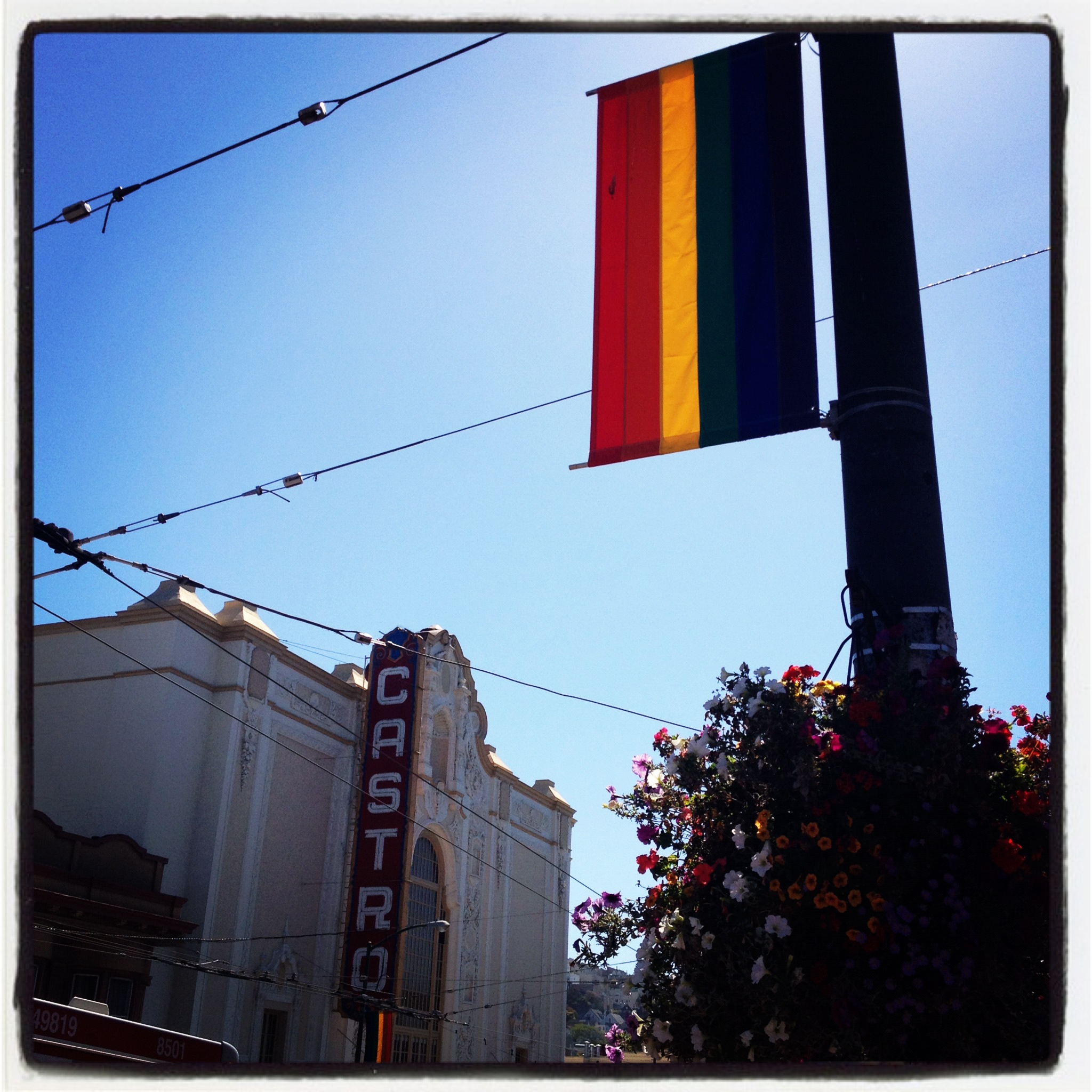
The colorfully tacky Castro niehgborhood is filling up, with the pulsing myriad of gay life that congregates here on destination weekends like Folsom. A fresh-faced lesbian with a smile on her face skips across the intersection of Church and Market. A pair of heavy set Latino boyfriends walk with their hands in each other’s back pockets, grinning toward the world like they are auditioning for a Coming Out Day poster. A surly heavy set lesbian double parks her car outside the pizza parlor across from the Castro Theater.
I keep returning to my unhappy epiphany that Troy has spent much of his romantic life living out lessons derived from his story of our break up, when my story would have been much less damaging to him, much more useful in building new healthy relationships. In his story, I simply stopped loving him one day.
In my story, once the crisis was over and I started to rebuild my life and my identity, I needed to step back, not step away. I needed him to hold my hand, rather than wrap his arms around me and protect me from the world. He was the perfect bulwark against the storm when it was raging, but when the storm had passed, I needed to take stock and rebuild my own defenses. But I didn’t mean to do it by pushing him away. I just needed him to give me enough space for me to stand on my own instead of being carried by him. I was too young to be able to articulate what I needed. And he was too young to consider an alternate explanation for why I needed him to loosen the tight grip he protected me with.
If I had a time machine, I would tell young Troy this: I still need you, but I need you to be my companion, not my shield.
But I can’t tell young Troy that, so I can only tell this Troy. And say that I’m sorry that I didn’t know how to say these things 15 years ago.
The stories that we tell about our history define us. The words and the narrative that we use to interpret our past become as important as the actual events in creating who we become.
That is one thing that I learned from this reconnection with Troy. And I realize that the story that I am telling myself about my break up from my recent ex is unfinished, and my current version is unhealthy. I am filling in the blanks with a narrative of sorrow and loss and grief.
I may not get my partner’s full story of our break up for awhile. And even if I do, I have to understand that distance and healing will probably change that story. But for me to survive and start to heal, I am letting go of the need to understand and explain. I am letting our story exist, unfinished, with pages left to fill but without the compulsion to fill them right away.
My story continues. I get back into my car. My history unwinds behind me, like the road in my rear view mirror, and my future reveals itself turn by twisting turn, unexpected vistas opening up in front of me when I least expect.

 Tom Is Tripping
Wow, this is so well written that I had to read it twice.
Thank you SO much. It’s my first attempt at blogging an I really appreciate the kind words!